
COMPLYFDA · ISSUE 2 · OCTOBER 2026
The Enforcement Signal
Data window: October 2026 · Source: ComplyFDA analysis of FDA enforcement activity
1 · SIGNAL OF THE MONTH
The quality unit drew the second-most warning letter citations in October 2026
In October 2026, 21 CFR 211.22, responsibilities of the quality control unit, drew 10 of 76 section-level citations in the FDA warning letters we track (13.2%). Only 211.84, testing and approval or rejection of components, drew more, with 12. 211.192, production record review, was third with 8.
211.22 is the anchor of Subpart B, Organization and Personnel, which was the largest subpart in October 2026 at 18 citations (23.7%). Together with 211.34 (consultants, 7) it accounts for nearly all of that subpart.
The section looks administrative, but it is the one investigators reach for when a firm’s other failures share a root cause: nobody with the authority to say no said no.
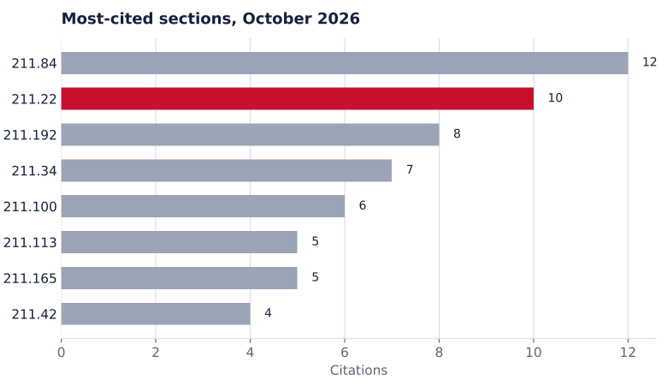
Figure: Most-cited sections, October 2026. ComplyFDA analysis of FDA warning letters. The data behind the chart is in the table below.
| Section | Total | Share |
| 211.84
Testing and approval or rejection of components |
12 | 15.8% |
| 211.22
Responsibilities of quality control unit |
10 | 13.2% |
| 211.192
Production record review |
8 | 10.5% |
| 211.34
Consultants |
7 | 9.2% |
| 211.100
Written procedures; deviations |
6 | 7.9% |
| 211.113
Control of microbiological contamination |
5 | 6.6% |
| 211.165
Testing and release for distribution |
5 | 6.6% |
| 211.42
Design and construction features |
4 | 5.3% |
| All section-level citations | 76 | 100% |
See the Pharmaceutical Insider Intelligence Report →
2 · WHAT’S DRIVING IT
- The quality unit signs, but it doesn’t decide. 22(a) gives the quality unit the responsibility and authority to approve or reject components, in-process materials, finished products and procedures. Many findings describe a unit that exists on the org chart but reports to production, has release decisions overridden, or simply never exercises the authority it holds on paper. Investigators read that as a missing quality unit, whatever the org chart says.
- Responsibilities that were never written down. 22(d) requires the quality unit’s responsibilities and procedures to be in writing and followed. Smaller manufacturers, including firms making CBD products or selling online, frequently have no written quality procedures at all. Without them there is nothing to show that oversight happens, and the citation follows almost automatically.
- The other findings land on the quality unit’s desk. When components go untested, deviations go uninvestigated or batch records go unreviewed, FDA often cites 211.22 alongside the specific section, because ensuring those things happen is the quality unit’s job. That is why 211.22 so often appears next to 211.84 and 211.192, and why fixing the specific gap without strengthening the unit rarely satisfies a warning letter response. The same applies to contract manufacturers and laboratories: their work is still yours to approve.
3 · WHERE THIS SHOWS UP IN YOUR SYSTEM
These are rules of thumb, not a formal assessment. Each one is a pattern that tends to come before a 211.22 citation.
☐ You can’t name a time quality said no and it stuck. If you can’t point to a rejected lot, a held release or a refused change that production pushed back on, an investigator may conclude the quality unit’s authority has never been tested.
☐ Quality’s responsibilities live in a job description, not a procedure. If the duties in 211.22 aren’t set out in an approved procedure that people actually follow, the unit’s oversight is hard to show and easy to cite.
☐ Your contractors’ records reach quality only when something goes wrong. If no one in your quality unit routinely reviews and approves the work of your contract manufacturer or laboratory, their gaps become your 211.22 finding.
How many apply to you?
0–1: Likely in reasonable shape. Confirm it with records of actual decisions, not just the SOP.
2: These are the gaps a 211.22 citation tends to follow. Prioritize them before your next inspection.
3: Treat quality unit authority and procedures as an inspection-readiness priority now, starting with who can overrule a release decision.
4 · THE INVESTIGATOR’S LENS
Show me a decision your quality unit made that production disagreed with. How was it resolved?
Investigators commonly ask a version of this question because it tests authority rather than paperwork. A firm with a working quality unit can produce a record: the lot or change in question, the quality decision, the disagreement and the documented outcome, with quality’s decision standing.
Before your next inspection, find two or three such examples and make sure the records are complete. If you can’t find any, that is worth understanding before an investigator asks.
5 · BEYOND THE HEADLINE
- 84 (components testing) was the most-cited section in October 2026 with 12 citations (15.8%), the only section ahead of 211.22.
- Records and Reports:192 (8) and 211.194 (3) helped make Subpart J the second-largest subpart at 14 citations (18.4%).
- Production and the lab:100 drew 6, and 211.113 and 211.165 tied at 5 each. Subpart F was third at 13 and Subpart I drew 10.
- Outside Part 211: one misbranding citation under 21 USC 352 and one GLP citation under 58.35 (quality assurance unit). Parts 207, 50, 56 and 312 drew none.
- Category tags: Controls appeared 30 times, Website 13 and CBD 12. Tags are counted separately from the section totals.
6 · GO DEEPER
| LEARN
Pharmaceutical Insider Intelligence Report ComplyFDA’s Pharmaceutical Insider Intelligence Report breaks down what FDA is citing in drug manufacturing, including component testing, and what firms did to close the gaps. $139 · Get it → |
| ASSESS
Process Baseline Assessment (typically about 10 days) We review your incoming materials, supplier qualification and quarantine processes against what FDA has been citing and give you a prioritized gap list. Request a demo or quote · Learn more → |
| MONITOR FEATURED THIS MONTH
483Pulse Track 211.84 and every other section month by month, so you see the next shift before it shows up in an inspection. $575 per person, annual subscription (group discounts on request) · Learn more → |
Methodology
ComplyFDA compiles FDA enforcement activity each month. Each issue covers a single month, describing that month only and makes no trend claims. A single letter can cite several sections, all figures are citation counts, not letter counts, and percentages are shares of section-level citations. Category tags are counted separately and are not added to the section totals. We do not compare against periods outside this window.
Disclaimer: This content is for general information only. It is not regulatory or legal advice and does not create a consulting relationship.