
COMPLYFDA · ISSUE 1 · SEPTEMBER 2026
The Enforcement Signal
Data window: Q3 2026 (July–September 2026) · Source: ComplyFDA analysis of FDA enforcement activity
1 · SIGNAL OF THE MONTH
Medical device reporting drew more Q3 2026 device warning letter citations than any other group
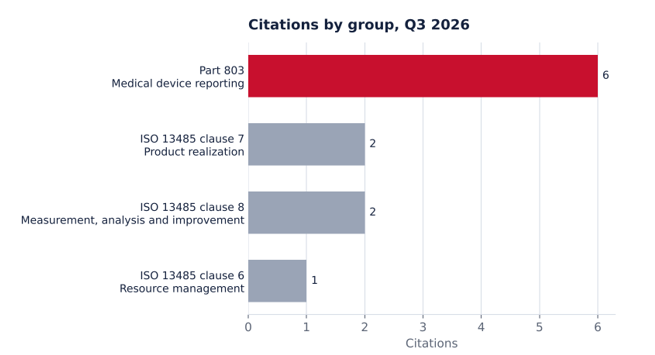
In Q3 2026 (July–September 2026), 21 CFR Part 803, Medical Device Reporting, drew 6 of 11 section-level citations in the device warning letters we track (54.5%). No other group came close: ISO 13485 clause 7 (product realization) and clause 8 (measurement, analysis and improvement) tied for second with 2 each.
The 6 Part 803 citations were spread across as many sections, one each: 803.12 (submitting initial and supplemental reports), 803.17 (written MDR procedures), 803.18 (MDR event files), 803.20 (completing an individual report), 803.50 (manufacturer reporting requirements) and 803.52 (what a manufacturer’s report must contain).
That spread is the signal. These citations don’t point to one missed deadline. They trace the whole reporting chain, from the written procedure to the file, the report and the submission, which points at the process rather than at a single late report.
Figure: Citations by group, Q3 2026. ComplyFDA analysis of FDA warning letters. The data behind the chart is in the table below.
| Group | Total | Share |
| Part 803
Medical Device Reporting |
6 | 54.5% |
| ISO 13485 clause 7
Product realization |
2 | 18.2% |
| ISO 13485 clause 8
Measurement, analysis and improvement |
2 | 18.2% |
| ISO 13485 clause 6
Resource management |
1 | 9.1% |
| All section-level citations | 11 | 100% |
See the Medical Device Insider Intelligence Report →
2 · WHAT’S DRIVING IT
- The clock starts earlier than the procedure says. 50 gives a manufacturer thirty calendar days from the day it becomes aware of information that reasonably suggests a device may have caused or contributed to a death or serious injury, or malfunctioned in a way that would be likely to if it recurred. Under 803.3, that awareness begins when any employee has the information, not when the complaint reaches the regulatory team. Procedures that start the clock at MDR review, or once a complaint is formally logged, build in delay.
- Reportability decisions that leave no trail. 18 requires MDR event files that hold the deliberations and decision-making used to decide whether an event was or was not reportable. When a firm concludes that a device did not cause or contribute to an event, 803.20 requires it to keep the information the qualified person relied on. A complaint closed as “not reportable” with a one-line rationale gives an investigator nothing to evaluate.
- Reports that are filed but never finished. 52 lists what a manufacturer’s report must contain, including the results of any device evaluation or an explanation of why none was done, and 803.50 makes the manufacturer responsible for investigating each event and evaluating its cause. When the investigation turns up information that wasn’t available for the first report, 803.56 calls for a supplemental report. Firms that submit once and never return to the file can be cited even though they did report.
3 · WHERE THIS SHOWS UP IN YOUR SYSTEM
These are rules of thumb, not a formal assessment. Each one is a pattern that tends to come before a Part 803 citation.
☐ Your MDR clock starts at complaint review, not at first awareness. If your procedure measures the reporting window from the day the complaint unit or MDR team receives a complaint, rather than the day anyone in the company first learned of the event, late reports are built in.
☐ Your “not reportable” decisions can’t be reconstructed. Pick a complaint closed as not reportable. If the file doesn’t show who decided, on what information and why, an investigator will treat the decision as undocumented.
☐ Nobody owns the supplemental report. If no one is assigned to send follow-up information once the device evaluation or investigation is finished, initial reports can stay incomplete indefinitely.
How many apply to you?
0–1: Likely in reasonable shape. Confirm it by sampling closed complaints, not by reading the procedure.
2: These are the gaps a Part 803 citation tends to follow. Close them before your next inspection.
3: Treat MDR as an inspection-readiness priority now, starting with when your procedure says the clock starts.
4 · THE INVESTIGATOR’S LENS
Walk me through how you decided this complaint was not reportable.
Investigators commonly ask a version of this question while sampling complaint files, because it tests the procedure, the people and the records at once. The answer they want is in the file: when the firm first learned of the event, who assessed it, what information they used and how they concluded it did not meet the reporting criteria.
The QMSR doesn’t change this. Since February 2, 2026, 820.10 has required a quality management system that conforms to ISO 13485:2016, and complaint handling sits in clause 8.2.2, but the reporting obligations themselves still come from Part 803. Before your next inspection, pull five recent complaints closed as not reportable and ask the question yourself. If the answer depends on someone’s memory instead of the record, start there.
5 · BEYOND THE HEADLINE
- Product realization and measurement tied for second. ISO 13485 clause 7 drew 2 citations (7.1, planning of product realization, and 7.6, control of monitoring and measuring equipment). Clause 8 also drew 2 (8.3.4, rework, and 8.5.2, corrective action).
- Resource management: clause 6.4.1, work environment, drew 1 citation, the only clause 6 finding in Q3 2026.
- Every QMSR citation came through an ISO 13485 clause. None cited a Part 820 section directly, such as 820.35 (control of records), and the file has no legacy Quality System Regulation citations.
- Tags, counted separately from the section totals: Validation appeared 5 times and Quality Procedures 4. Quality Controls and Production Control Records appeared 3 times each.
6 · GO DEEPER
| LEARN
Medical Device Insider Intelligence Report ComplyFDA’s Medical Device Insider Intelligence Report breaks down what FDA is citing in device quality systems, including complaint handling and MDR, and what firms did to close the gaps. $139 · Get it → |
| ASSESS
Process Baseline Assessment (typically about 10 days) We review your incoming materials, supplier qualification and quarantine processes against what FDA has been citing and give you a prioritized gap list. Request a demo or quote · Learn more → |
| MONITOR FEATURED THIS MONTH
483Pulse Track 211.84 and every other section month by month, so you see the next shift before it shows up in an inspection. $575 per person, annual subscription (group discounts on request) · Learn more → |
Methodology
ComplyFDA compiles FDA enforcement activity each month. Each issue covers a single month, describing that month only and makes no trend claims. A single letter can cite several sections, all figures are citation counts, not letter counts, and percentages are shares of section-level citations. Category tags are counted separately and are not added to the section totals. We do not compare against periods outside this window.
Disclaimer: This content is for general information only. It is not regulatory or legal advice and does not create a consulting relationship.